Pages

Showing posts with label Tech. Show all posts
0
Nokia 888: the Bendable Phone

Nokia 888, Coolest Cell PhonesYou can roll it, bend it, put on your clothes like a clip. It also makes some form changes that makes it more ergonomical: when you want to talk on the phone, the body form turns into the form of the good old telephone. You can personalize these forms and record them, so it fits you the best in the way that you have chosen. It is powered by liquid battery, and it uses a touchscreen display.

Hyundai MP-280: the Perfume Phone

Hyundai MP-280, Coolest Phone, the Perfume Phone

For woman, or man who care about their body smell, Hyundai presents the MP 280 cell phone, a clamshell phone with a built-in perfume container! Upon opening the phone to make or receive a call, the scent will be released. Once it's not as smelly as before or in other words, the perfume has almost empty, you can refill it.

Furthermore, MP280 comes with a syringe which you can fill with your favorite perfume. The butterfly object at the centre of the phone is where you "inject" the perfume into the handset. About 2 drops of the concentrate are enough to last about 8 hours. Apart from the perfume thing, the phone has a changeable cover panels which make it more attractive to customers.

Telson TWC 1150: the Camera Phone Watch

Telson TWC 1150, the Camera Phone Watch, Coolest Phone

The Watch Phone weighs only 98 grams. Telson TWC 1150 packs in a lot of features including loudspeaker, voice recording and voice recognition capability, infrared earpiece and polyphonic ring tones. It also has a speakerphone facility along with infrared "Finger-Ring" type earpiece. The high performance battery of the phone enables talk time up to 100 minutes and standby time up to 150 hours.

Telson TWC 1150 is equipped with a plug-in high-resolution 330,000 pixel digital camera that is included in the handset kit. It has a capacity to save up to 80 pictures which can be attached to the unique phone book. The Phone Book has a facility to store up to 200 entries with 4 numbers, email id and URL and Photo caller id so that whenever you receive calls the photo of the caller will be displayed on the screen. One can even set up to seven blinking colours depending on the caller's group.

SparkFun Port-O-Rotary: the Portable Rotary Phone

Coolest Phone, SparkFun Port-O-Rotary, the Portable Rotary Phone

a fully functional GSM cell phone stuffed into an old rotary phone. It makes an interesting conversation piece to say the least. All you have to do is open the phone, insert your SIM card, and turn the unit on. The unit will utilize your phone number and account minutes. Phone can dial out using the rotary and will ring with the original metal bells with an incoming call.

The GM862 cellular module from Telit works within any country that has one of the 900MHz/1800MHz/1900MHz cellular bands (90% of the world). Each phone is specially built to customer needs. The battery can run the phone for 4-5 days and is charged by unscrewing two screws on the bottom of the phone, opening it, and attaching the charger.

NOKIA SURV1: the Waterproof and Outdoorsy Phone

NOKIA SURV1, Coolest Phone, the Waterproof and Outdoorsy Phone

The SURV1 concept features a rugged and waterproof frame based design for cellphone, The concept is targeted at users who spend a lot of time outdoors. The phone can be worn as a belt clip or a big sized pendant and uses only touchscreen without any buttons (except for emergency).

The scratch resistance high resolution screen can also be used as a flashlight. The concept also includes GPS capabilities and MP3 player for music enthusiasts.

Vodafone 904SH: the Phone With Face Recognition

Vodafone 904SH, Coolest Phone

The Sharp 904SH available with Vodafone Japan is probably the most secure phone as it uses Face recognition. The phone can be programmed to recognise the face of the user and it will remain locked and keep anyone from accessing its memory / functions until the handset verifies that the face is that of its user. You also get a "Motion Sensor" that allows you to use your phone in a similar way to the Nintendo Revolution controller. with Bluetooth enabled on 2 similar phones and a fighting game, you can pull a Darth Vader on your opponent. There's also a Java Messenger-clone... and, oh yes, you can also make calls with it.

Dbtel M50: the iPod-Like Phone


Love the iPod dial pad? This phone can really give you the feel of it with phone integration. The 4 button let you open the phone menu, anwer calls, cancel action and end your calls. The dial pad is the one which detect your motion. Around the dial pad has also 4 music player functions. Once you confirm your music song, you can click the center round button to play it.

The display screen doesn't come cheap. It's a touch screen where you can activate the number pad by just one touch on the screen. Also incldes: a 2.0 Megapixel Camera, GPRS, USB, Mini-SD, IrDA, Pen-base, and more.

BenQ Qube Z2: Little Cube-Shaped Phone

BenQ Qube Z2, Little Cube-Shaped Phone, Coolest Phone

The keypad is vertically aligned in two rows on the right of the screen, while navigational buttons reside along the bottom. It comes with full-function MP3 player with lyrics display, voice recorder, FM radio and 3D surround sound. Packed with 60MB embedded memory to store pictures taken with its 1.3 megapixel camera, and a mini SD card slot for expanded memory.

Nokia Colores: the Virtual Hard Drive

Coolest Phone, Nokia Colores, the Virtual Hard Drive

The concept device features the first "virtual" hard drive that provides local and remote access to all your essential information and converges the features of multiple devices into a single device, with an innovative UI. It also includes GPS, GPRS, recording device that transforms speech into text, biometric scanner for fingerprint recognition, 3G CDMA2000 1xEV-DO, Google Earth, carbon fiber structure.

Samsung Serene: the Elegant Phone

Samsung Serene, the Elegant Phone, Coolest Phone

This phone is unique not because Samsung builds it, but because Bang & Olufsen has designed it. If you take a look at the phone it's a completely unique design: that the screen is intended to be the bottom of the phone with the keypad representing the top half. Why flip the screen? Because by placing the screen on the bottom the user no longer places his or her ear onto the screen causing it to become greasy. Bang and Olufsen's minimalism is present throughout the design. There is no screen on the outside, the keypad is circular like b&o remote, and the ring tones are noticeable yet unobtrusive pings which make the phone all the more elegant. The Serene's unique design comes in a small package. The price? €1100

[Source]
Modern Shipping WorldFor those who think that the glory-days of boat-building are over, think again – for there are modern-day Brunels, eager to build the next generation of ocean-faring superstructures. Here are 7 wondrous examples of epic modern ship design, from passenger liner to man o’ war, from staggeringly large to stealthily small – all demonstrating that when it comes to innovation, technology and breadth of ambition, the best designs are the ones making waves.

Knock Nevis
(Images via: Dark Roasted Blend)

Longer than the Eiffel Tower is tall, the Knock Nevis is a floating colossus with a fascinating history. Originally built in a Japanese shipyard for a Greek owner who couldn’t take delivery, the ship has had multiple owners, endured three name-changes and, while being used as a storage ship by Iran in 1988, been bombed and sunk by Iraqi jets. Today this near-half-kilometer-long behemoth can be seen permanently moored at the Al Shaheen oil fields, Qatar, where (as the Knock Nevis) it is being used as an FPSO.


Batillus, Modern Ship
(Image via: Relevant Search Scotland)

However, the title of Largest Ship In The World belongs to the Batillus-class supertankers of the late 1970s, each weighing in at around half a million tonnes deadweight. Massive they may have been, but all but one of these ships lasted less than a decade – the longest-lived was the Prairial, finally scrapped in Karachi in 2003.


Oasis of The Seas, Modern Ship
(Image via: Oasis of the Seas)

Fancy sailing the world’s oceans atop a skyscraper? You’ll want to book passage on the Oasis of The Seas , the first in Royal Caribbean International’s new fleet of cruise ships…and the largest passenger vessel in the world.

Oasis of The Seas, Modern Ship
(Images via: Oasis of the Seas)

Launched from Finland last month, the OotS is currently heading towards Fort Lauderdale on its maiden voyage. 70 meters high, 360 meters long and a whopping 225,000 tons (that is over four times heavier than the Titanic), it offers its passengers an astounding variety of luxuries including two-storey apartments, a mini golf course and an indoor park. Cruise travel gone mad?


Super Eco Ship 2030, Modern Ship
(Images via: Crunch Gear via Ecofriend)

Attempting something a little eco-flashier is the Super Eco Ship 2030 (due to hit the seas in…well, have a guess). The ship is powered by hydrogen fuel cells and onboard solar and wind energy collectors – and with the help of a lightened, friction-reduced hull, the designed claim a 69% drop in carbon dioxide emissions compared with today’s container ships.


Freedom Ship, Modern Ship
(Images via: Freedom Ship)

Less a ship than a mindbogglingly huge chain of barges, the Freedom Ship is a vessel on a scale that even Roland Emmerich would raise an eyebrow at. It would house over 60,000 passengers (maybe even up to 100,000 at a squeeze) and would contain everything a modern community needs – even its own airport, turboprop-only. Where is it now? Lost in a sea of blueprints, without publicized investors (and at an estimated price of $11 billion this project needs a lot of them) and the target of accusations of scamming. If completed, the Freedom Ship would cruise round the world – and we have to ask, what exactly is it like to ride out a tropical storm in an oversized barge?


Visby-Cass Stealth Corvette, Modern Shipping
(Images via: 800HighTech)

Dear modern sea-pirates: how would you feel if one of these sidled alongside your scurvy vessel and ordered you to drop anchor? Meet the Visby-class stealth corvette, darling of the Swedish Navy.


Star Destroyers, Modern Shipping
(Images via: 800HighTech and Gizmodo)

Gizmodo likens them to waterborne Star Destroyers, and we see their point. These warships are designed to sneak under the radar at any distance above 13 miles in calm seas, thanks to advanced materials in its armored cladding and a greatly dampened electromagnetic footprint – and once up close, its guns, missiles, depth charges, torpedoes and grenade launchers would be sure to get the attention of even the most heavily-armed ship of hijackers.


Zumwalt-Class Destroyer
(Image via: US Navy)

But for sea-policing at a disance, the prize goes to US Navy’s upcoming Zumwalt-class destroyer – a $3.3 billion, 21st-Century version of the ironclad. Thanks to stealth technologies its radar signature will be little larger than a fishing boat…

Zumwalt-Class Destroyer
(Images via: US Navy and Wired)

…which would belie the truly formidable punch behind this hunter-killer, including an advanced gun system firing 10 rounds a minute to a range of 80 miles. Guided missiles can also be flung out the well-protected vertical launch tubes – and it has even been suggested that railguns and lasers might make up its future arsenal. For now, its cutting-edge nature means that a number of key technologies have yet to be fully developed. In every sense, this is a ship of the future.


Amphibious Pavilion, 2012 World Expo

And last but not least, we have a ship that isn’t a ship at all – it’s a floating exhibition centre. This design, created for the 2012 World Expo in South Korea, is a pavilion with a difference…

Amphibious Pavilion, 2012 World Expo
(Images via: Inhabitat)

…because once the show is over, it can be detached from the shoreline and sailed elsewhere, drawn behind a tug. It may not be self-powered, but a ship it most definitely is – and one that would be towed around the South Korean coastline to wherever it is needed. The possibilities are intriguing: how about a theater where the venue goes on tour with the company? And is this the start of shipping that has a dual role, embedded in the seaward sides of our cities to perform an entirely different service to the community?

[Source]
Google TVIf the discovery of down-to-the-cent leaked prices for Sony's Google TVs sounded too good to be true, you might have been partially right -- the publication that reported that the sets would range from $1,299 to $1,899 has now backed away from those figures.

Sony Insider says that though its original prices seemed legit, the website's spooks inside Sony now claim they'll actually cost less when they hit the market, though the screen sizes and model numbers were apparently on the money. We don't really feel inclined to trust the new anonymous sources any more than the original anonymous sources, so we'll just leave it at that so as not to get you excited -- if they're cheaper after all, we'll celebrate, and if not we'll be forewarned.

[Source]
LooxcieRemember those early wireless headsets, the ones that made people look like they had been assimilated by The Borg? Few would seek to return to those days for the benefit of bridging a handset and one's ears. But what if one could also bridge a handset and one's eyes? That's essentially the promise of Looxcie, a Bluetoooth headset that integrates a video camera to enable passive video capture.

Looxcie's creators note that using the device requires less encumbrance than even a Flip camcorder. Still, there's no getting around it -- the Looxcie is no spy gadget. Accepting the state of the technology for what it is, the designers chose to embrace its size rather than try to minimize it. The protuberance that houses the boom mike and lens of the product swells toward an end that includes a red recording light. The extension in a glossy white, perhaps an homage to massive telephoto zoom lenses like those from Canon.

The Looxcie, though, cannot zoom (even digitally). It can, though, rotate about 10 degrees clockwise or counterclockwise to compensate for the position of the head, which can make for both a solid stabilizer and finicky focal source. Despite its large size, the Looxcie is reasonably comfortable, although positioning it so that the camcorder is capturing what you're seeing while keeping the earpiece in your ear can be tricky.

The Looxcie is also a Bluetooth audio headset, and works in tandem with the screen of the smartphone to create a a kind of "DLR" (Digital Life Recorder). The generally well-designed Looxcie software maintains a cache of everything that you're watching as long as the camcorder is turned on. And just like most DVRs have an "instant replay" feature, you can save an instant clip by pressing a button on the underside of the camera. The Looxcie software can e-mail these clips or post them to YouTube or Facebook, and the whole cache can be sent to a PC for further editing.
As Looxcie's video gets better and its profile gets smaller, it could become a viable tool for capturing those ephemeral moments that would otherwise be lost.
While the size and prominence of the Looxcie hardware will certainly make it a nonstarter for many, video quality is actually a bigger obstacle -- capture tops out at about 10 frames per second. This is no doubt in part a limitation of the Bluetooth connection between the headset and the phone. Perhaps Looxcie could improve video quality by recording its cache and clips to a microSD card in the headset, and send clips to the phone after a short delay. As it stands now, however, Looxcie embodies a number of paradoxes. It is intended to capture spontaneity, but the stigma of its size disincentives use. And it allows you to capture that which you normally couldn't, but at quality that you normally wouldn't.

Still, one can see a few uses for Looxcie. These might include capturing events where the audio is generally more important than the video -- say, a lecture or conference panel. Another is where you expect something to happen but you don't know when, such as the whale-watching cliche where everyone misses the animal cresting (although even here one would get better results just mounting something like a Kodak PlaySport to a railing). Then there's capturing adventures in casual sports, in which Looxcie can be an alternative to active sports cams like those from Contour that generally need to be mounted on a helmet or other gear.

Of course, one of Looxcie's real strengths is its ability to upload clips in nearly real-time, where the low quality of its clips translates into faster uploads. It makes YouTube a truer extension of "you" and sends video to Facebook directly from your face. Once upon a time, cell phones and even digital cameras captured QVGA stills. As Looxcie's video gets better and its profile gets smaller, it could become a viable tool for capturing those ephemeral moments that would otherwise be lost.

[Source]
Steve Jobs
Steve Jobs of Apple is making yet another big announcement today.

There are two cultural events that will persuade geeks to play “Wookie Hookie” — to call in sick at school or work: a new installment of “Star Wars” and a Steve Jobs keynote.

All over the world, from London to China, Apple fans are preparing to feign illness in order to tune into Jobs’ Apple announcement today, which is being live streamed over the internet for the first time in many years.

When Jobs takes the stage in his trademark turtleneck, jeans and sneakers, he promises a thrilling show of Apple’s latest sales statistics followed by some new products. According to a report in the Wall Street Journal, “Frothy anticipation about Apple’s event Wednesday has centered on music and expected updates to iTunes and the iPod lineup. But television also is likely to be on the menu.”

“Awesome,” says one commentator on the MacRumors forums. “I can watch this instead of paying attention on the first day of high school.”

It’s astonishing that Jobs has managed to turn the most boring event in the catalog of boring events — a corporate press conference — into a global cultural phenomenon to rival rock star concerts or big sports events. Indeed, Jobs’ iPod/AppleTV event will attract far more attention than this year’s Coachella.

All across the net, websites are buzzing with news of the surprise broadcast, and instructions of how tune in and ensure a good, glitch-free stream. For several weeks, blogs and websites have been reporting every rumor and snippet of information about what he might have up his sleeve.

Significantly, these rumors are reported by big, mainstream news organizations. A couple of years ago, major news organizations would never deign to report Apple rumors. Today, whatever he reveals will be splashed across TV news broadcasts, newspapers and websites.

Jobs has always been a tech cult hero. Apple fans would line up overnight to snag seats at his Macworld speeches. They would fill the hall with wild whoops and cheers. Some had laptops open, ready to immediately order whatever product he unveiled.

But these days, we’re all geeks. Everyone’s got an iPod, an iPhone or an iPad, and it seems the whole world eagerly awaits to see what Jobs will do next.

There are few figures in business — or culture for that matter — who have had an impact as big as Jobs. Not only did he help invent the PC industry in the late 70s (and then reinvent it in the 80s with the Mac), he’s helped define computer animation, digital music, and now the smartphone business and mobile computing. Jobs’ products aren’t just industry leading, they’re cultural artifacts. The iPod is as emblematic to the times as were 78s, jukeboxes or the Walkman.

No wonder there’s such interest in his next move — it could be big.

Geek culture is a new counterculture — a world full of amazing products and films, music and games for people who are proud to be nerdy and square.

Chief among their heroes is Jobs, a figure from 60s counterculture who has single-handedly made computing cool. Jobs has made the products cooler than the media they play.

The iPad is infinitely cooler than the new album by Arcade Fire. In the sixties, it was the Stones. These days, it’s Jobs’ “One last thing.”

[Source]
0
This is one of those subjective lists that many people will agree with and many will not. I have chosen what I think are the greatest modern inventions and listed them from least to most important. Feel free to use the comments to add to the list or to debate my choices.10. Modern Plumbing

Toto Soiree Toilet

The ability to remove sewage from and bring clean water into places of dense human habitation makes the modern city possible. Without it, we’d still have cities, but not like the ones we know. A high-rise building would be impossible, really, without toilets and plumbing. Remove apartment buildings, office towers, and dense downtown cores from your picture of the world and you have to change the whole rest of your picture too, because the implications keep rippling.

9. Printing Press

Printing Press

The printing press was the first one of many communication mediums, changing how information was collected, stored, retrieved, criticized, discovered, and promoted. It has been implicated in the Reformation, the Renaissance and the Scientific Revolution. Johannes Gutenberg is credited with inventing the first printing press in the Western civilizations of Europe. Screw presses for olives and wine had been known in Europe since Roman times; presses for the binding of manuscript books were also in use. Gutenberg was the first to convert the concept for printing uses. Gutenberg’s use of mechanical presses along with other innovations made printing a proto-industrial process with a far greater output compared to manuscripts made by copyists.

8. Automobile

Bentley Continental GT

In 1769, the very first self-propelled road vehicle was invented by French mechanic, Nicolas Joseph Cugnot. However, it was a steam-powered model. In 1885, Karl Benz designed and built the world’s first practical automobile to be powered by an internal-combustion engine. In 1885, Gottlieb Daimler took the internal combustion engine a step further and patented what is generally recognized as the prototype of the modern gas engine and later built the world’s first four-wheeled motor vehicle.

7. Pesticides

Pesticides

Since before 2500 BC, humans have used pesticides to prevent damage to their crops. The first known pesticide was elemental sulfur dusting used in Sumeria about 4,500 years ago. By the 15th century, toxic chemicals such as arsenic, mercury and lead were being applied to crops to kill pests. In 1939, Paul Müller discovered that DDT was a very effective insecticide. It quickly became the most widely-used pesticide in the world. However, in the 1960s, it was discovered that DDT was preventing many fish-eating birds from reproducing which was a huge threat to biodiversity. Pesticide use has increased 50-fold since 1950, and 2.5 million tons of industrial pesticides are now used each year.

6. Steam Engine

Steam Engine

Thomas Savery was an English military engineer and inventor who in 1698, patented the first crude steam engine. Thomas Newcomen invented the atmospheric steam engine in 1712. James Watt’s incarnation of the steam engine ushered in the Industrial Revolution. His centrifugal governor kept the engine running at the desired rate, and is a modification so simple and elegant that it may be one of the best ideas of all time.

5. Computers

Apple Macbook Pro 2 Ghz Core Duo Laptop

In 1837, Charles Babbage was the first to conceptualize and design a fully programmable mechanical computer that he called “The Analytical Engine”. Due to limited finance, and an inability to resist tinkering with the design, Babbage never actually built his Analytical Engine. Large-scale automated data processing of punched cards was performed for the U.S. Census in 1890 by tabulating machines designed by Herman Hollerith and manufactured by the Computing Tabulating Recording Corporation, which later became IBM.

4. Transistors

Transistors

The transistor is the fundamental building block of the circuitry that governs the operation of computers, cellular phones, and all other modern electronics. On 16 December 1947 William Shockley, John Bardeen and Walter Brattain succeeded in building the first practical point-contact transistor at Bell Labs. This work followed from their war-time efforts to produce extremely pure germanium “crystal” mixer diodes, used in radar units as a frequency mixer element in microwave radar receivers.

3. Plastic

Plastic

Plastic is composed of organic condensation or addition polymers and may contain other substances to improve performance or economics. There are few natural polymers generally considered to be “plastics”. The first plastic based on a synthetic polymer was made from phenol and formaldehyde, with the first viable and cheap synthesis methods invented by Leo Hendrik Baekeland in 1909, the product being known as Bakelite. Subsequently poly(vinyl chloride), polystyrene, polyethylene (polyethene), polypropylene (polypropene), polyamides (nylons), polyesters, acrylics, silicones, polyurethanes were amongst the many varieties of plastics developed and have great commercial success.

2. Harnessed Electricity

Harnessed Electricity

Electricity existed all along, but the system of devices needed to generate this force and distribute it to individual buildings was an invention, launched initially by Edison: He effectively turned electricity into a salable commodity and his Pearl Street station was the world’s first electric power station. Nikola Tesla’s invention of alternating current (AC) technology then made it possible to transmit electricity over long distances, leading to the nationwide grid we know today. Now, anyone in the West and throughout most of the world can tap into the grid to power everything from light bulbs to computers.

1. Immunization / Antibiotics

Immunization Antibiotics

Three centuries ago, almost everyone died of infectious diseases. When the plague broke out in 1347, it killed nearly half of Europe–in about two years. When diseases such as smallpox reached North America, they reduced the indigenous population by about 90 percent within a century. As late as 1800, the leading cause of death in the West was tuberculosis. Hardly anyone died of old age back then, one reason why elders were revered. Today, elders are a dime a dozen: nothing unusual about surviving past 70. In the United States, 73 percent of people die of heart failure, cancer, and stroke.

Notable others: Laser, Radio, Clock

[Source : Listverse]
With all the discussion around the net regarding the new 7 wonders of the world, I thought that a nice complement to that would the be the 7 wonders of the technological world. I searched around for inspiration and was surprised to find that no one has put together a really decent list. One of the prominent lists I did find included Microsoft Surface – how ridiculous! (I wonder who owns that newspaper). So, without further ado, here is the list of the Top 7 Wonders of the Technological World.7. iPod

iPod

This item will be the most controversial on the list I think. My reason for including it is the impact it has had worldwide on how we listen to music, how we buy music, and how we perceive entertainment as a whole. The iPod was not the first portable digital music device, but it has undoubtedly had the most effect of all. It has spawned an entire industry of supporting gadgets and accessories and it has been the basis of the only successful attempt by any company to break the Recording Industry’s hold on music distribution. For that alone, we owe Apple Corporation a big thank you.

Apple’s hardware engineering chief, Jon Rubinstein, assembled a team of engineers to design the iPod, including Tony Fadell, hardware engineer Michael Dhuey, and design engineer Jonathan Ive, with Stan Ng as the marketing manager. The product was developed in less than a year and unveiled on October 23, 2001. CEO Steve Jobs announced it as a Mac-compatible product with a 5 GB hard drive that put “1000 songs in your pocket.”

6. International Space Station

International Space Station

Some 60 years ago the world was plunged in to one of the greatest wars known to man. Not so many years after that we were thrown in to the cold war. Who would have believed that before the end of the 20th century, countries that were bitter enemies for the larger part of the century would join together to create a space station? The countries participating at present are the United States, Russia, Japan, Canada, and numerous European nations. The Space Station has enabled us to learn that we can work together peacefully, especially in the pursuit of scientific knowledge.

In the early 1980s, NASA planned Space Station Freedom as a counterpart to the Soviet Salyut and Mir space stations. It never left the drawing board and, with the end of the Soviet Union and the Cold War, it was cancelled. The end of the Space race prompted the U.S. administration officials to start negotiations with international partners Europe, Russia, Japan and Canada in the early 1990s in order to build a truly international space station. This project was first announced in 1993. The first section, the Zarya Functional Cargo Block, was put in orbit in November 1998 on a Russian Proton rocket.

5. Linux

Linux

Linux has to be on the list for the very fact that it truly opened the door to Open Source software to more people than any other open source project. The very fact that so many people can work together without meeting face to face to bring together such a complex project as an operating system – and to make it good enough to compete with the giants in the industry, is a wonder in itself. The project started as the brain child of Linus Torvalds.

In 1991, Linus Torvalds began to work on a non-commercial replacement for MINIX (another Unix-like operating system) while he was attending the University of Helsinki. With code from the GNU system freely available, it was advantageous that this could be used with the fledgling OS. Torvalds initiated a switch from his original license (which prohibited commercial redistribution) to the GNU GPL. Linux and GNU developers worked to integrate GNU components with Linux to make a fully functional and free operating system.

4. Hubble Space Telescope

Hubble Space Telescope

Since its launch in 1990, the Hubble Space Telescope has become one of the most significant instruments in the history of astronomy. Children of today do not need to look in to the sky and wonder – Hubble has brought the beauty of the heavens to the face of the earth. The Hubble telescope has enabled a multitude of incredibly discoveries about our universe and origins to be made. It has also provided us with some of the most beautiful images of all time. To understand the true value of this telescope, consider the Hubble Ultra Deep Field – the deepest image of the universe ever taken in visible light, looking back in time more than 13 billion years. It is impossible to look at this image and not feel a sense of awe at the technological achievement that made it possible. For your viewing pleasure, here is a full 3100 × 3120 pixel copy of the HUDF.

The history of the Hubble Space Telescope can be traced back as far as 1946, when the astronomer Lyman Spitzer wrote the paper Astronomical advantages of an extra-terrestrial observatory. Spitzer devoted much of his career to pushing for a space telescope to be developed. In 1962 a report by the U.S. National Academy of Sciences recommended the development of a space telescope as part of the space program, and in 1965 Spitzer was appointed as head of a committee given the task of defining the scientific objectives for a large space telescope. On April 24, 1990, Space Shuttle Discovery launched in Florida, taking the Hubble Space Telescope in to space.

3. Lasers

Lasers

When lasers were invented in 1960, they were called “a solution looking for a problem”. Since then, they have become ubiquitous, finding utility in thousands of highly varied applications in every section of modern society, including consumer electronics, information technology, science, medicine, industry, law enforcement, entertainment, and the military. Every day virtually every person is effected in one way or another by lasers. In the medical field, lasers have revolutionized surgery and we can now restore sight to the near-blind with their help.

With its origins in the theories of scientists like Einstein, in 1960 Theodore H. Maiman created the first working laser at Hughes Research Laboratories in Malibu, California. It used a solid-state flashlamp-pumped synthetic ruby crystal to produce red laser light at 694 nanometres wavelength. Later that year, Iranian physicist Ali Javan, working with William Bennet and Donald Herriot, made the first gas laser using helium and neon.

2. The Computer

The Computer

There will be no controversy about this entry. The computer has changed the world so much that we could say we are now living in the computer age, having left the industrial age well behind us. Computers are used in virtually every arena of human life – including medicine, science, crime detection, entertainment, and much much more. The computer has revolutionized so many aspects of our lives that it is now hard to imagine life without it.

In 1837, Charles Babbage was the first to conceptualize and design a fully programmable mechanical computer that he called “The Analytical Engine”. Due to limited finance, and an inability to resist tinkering with the design, Babbage never actually built his Analytical Engine. Large-scale automated data processing of punched cards was performed for the U.S. Census in 1890 by tabulating machines designed by Herman Hollerith and manufactured by the Computing Tabulating Recording Corporation, which later became IBM.

1. The Internet

The Internet

A visualization of the Internet

Admittedly, without computers, we would not have the Internet, but the Internet far supersedes the computer in order of importance. It is fair to say that the Internet is the new Library of Alexandria. The Internet now stores an immense portion of human knowledge and it is not just available to an elite few – it is available to every man, woman, and child in the free world. For many of us, our daily life relies heavily on the internet – not just for information gathering and research, but for shopping, entertainment, news, and communication. It allows us to speak to any person on the planet without the high costs imposed by telephone companies. The Internet has launched the careers of many great artists – people who would normally be overlooked by the mainstream industries they work in. There can be no doubt, the Internet is the greatest wonder of the technological world.

The USSR’s launch of Sputnik spurred the United States to create the Advanced Research Projects Agency, known as ARPA, in February 1958 to regain a technological lead. After much work, the first node went live at UCLA on October 29, 1969 on what would be called the ARPANET, one of the “eve” networks of today’s Internet. The first TCP/IP-wide area network was operational by January 1, 1983, when the United States’ National Science Foundation (NSF) constructed a university network backbone that would later become the NSFNet. It was then followed by the opening of the network to commercial interests in 1985. Important, separate networks that offered gateways into, then later merged with, the NSFNet include Usenet, BITNET and the various commercial and educational networks, such as X.25, Compuserve and JANET.

[Source : Listverse]
0
Digisync Film KeyCode Reader
  • Digisync film barcode readers are designed to read the machine readable barcode edge numbers on the motion picture film.
  • Readers are available for a wide range of applications, including telecine transfer, negative breakdown, workprint logging, edit list generation, color timing and negative conforming.
  • Digisync can be used with database/production management software to provide a powerful tool for facilitating both film and film/video post production.
  • The flagship of our product line is the Digisync Console. It provides the most powerful Keycode reading and film counter capabilities available today.
  • We can also provide you with a range of Synchronisers and reader heads.
[Source]
0
Large Hadron Collider The Large Hadron Collider (LHC) is the world's largest particle accelerator complex, intended to collide opposing beams of 7 TeV protons. Its main purpose is to explore the validity and limitations of the Standard Model, the current theoretical picture for particle physics. The LHC was built by the European Organization for Nuclear Research (CERN), and lies underneath the Franco-Swiss border near Geneva, Switzerland.
The LHC is the world's largest and the highest-energy particle accelerator. It is funded by and built in collaboration with over eight thousand physicists from over eighty-five countries as well as hundreds of universities and laboratories.
The LHC is now operational, and in the process of being prepared for first collisions. The first beam was circulated through the collider on the morning of September 10th, 2008. The first high-energy collisions are planned to take place after the LHC is officially unveiled on 21 October 2008.

When activated, it is theorized that the collider will produce the elusive Higgs boson, the observation of which could confirm the predictions and missing links in the Standard Model of physics and could explain how other elementary particles acquire properties such as mass.
Although a few individuals have questioned the safety of the planned experiments in the media and through the courts, the consensus in the scientific community is that there is no basis for any conceivable threat from the LHC particle collisions.

Technical design
The LHC is the world's largest and highest-energy particle accelerator. The collider is contained in a circular tunnel with a circumference of 27 kilometres (17 mi) at a depth ranging from 50 to 175 metres underground. The 3.8 metre (150 inches) diameter, concrete-lined tunnel, constructed between 1983 and 1988, was formerly used to house the LEP, an electron-positron collider. It crosses the border between Switzerland and France at four points, although most of it is in France. Surface buildings hold ancillary equipment such as compressors, ventilation equipment, control electronics and refrigeration plants.

The collider tunnel contains two adjacent beam pipes, each containing a proton beam (a proton is one type of hadron). The two beams travel in opposite directions around the ring. Some 1,232 bending magnets keep the beams on their circular path, while an additional 392 focusing magnets are used to keep the beams focused, in order to maximize the chances of interaction between the particles in the four intersection points, where the two beams will cross. In total, over 1,600 superconducting magnets are installed, with most weighing over 27 tonnes. Approximately 96 tonnes of liquid helium is needed to keep the magnets at the operating temperature (1.9K), making the LHC the largest cryogenic facility in the world at liquid helium temperature.
Once or twice a day, as the protons are accelerated from 450 GeV to 7 TeV, the field of the superconducting bending magnets will be increased from 0.54 T to 8.3 T.

LHC quadrupole magnets The protons will each have an energy of 7 TeV, giving a total collision energy of 14 TeV. At this energy the protons have a gamma factor of about 7,500 and move at about 99.999999% of light speed. It will take less than 90 microseconds for a proton to travel once around the main ring (a speed of about 11,000 revolutions per second). Rather than continuous beams, the protons will be bunched together, into 2,808 bunches, so that interactions between the two beams will take place at discrete intervals never shorter than 25 ns apart. When the collider is first commissioned, it will be operated with fewer bunches, to give a bunch crossing interval of 75 ns. The number of bunches will later be increased to give a final bunch crossing interval of 25 ns.
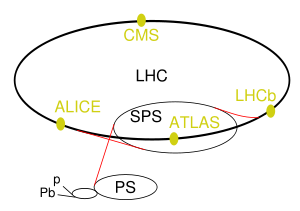
Prior to being injected into the main accelerator, the particles are prepared by a series of systems that successively increase their energy. The first system is the linear accelerator Linac 2 generating 50 MeV protons, which feeds the Proton Synchrotron Booster (PSB). There the protons are accelerated to 1.4 GeV and injected into the Proton Synchrotron (PS), where they are accelerated to 26 GeV. Finally the Super Proton Synchrotron (SPS) is used to increase their energy to 450 GeV before they are at last injected (over a period of 20 minutes) into the main ring, where proton bunches are accumulated, accelerated (over a period of 20 minutes) to their peak 7 TeV energy, and finally stored for many hours (10 to 24) while collisions occur at the four intersection points.

The LHC will also be used to collide lead (Pb) nuclei with a collision energy of 1,150 TeV. The Pb ions will be first accelerated by the linear accelerator Linac 3, and the Low-Energy Injector Ring (LEIR) will be used as an ion storage and cooler unit. The ions then will be further accelerated by the Proton Synchrotron (PS) and Super Proton Synchrotron (SPS) before being injected into LHC ring, where they will reach an energy of 2.76 TeV per nucleon.

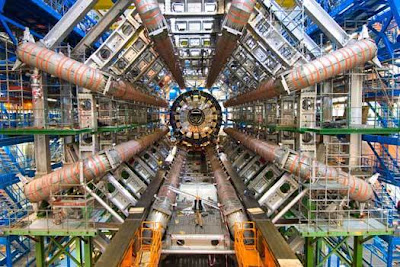
Six detectors are being constructed at the LHC, located underground in large caverns excavated at the LHC's intersection points. Two of them, the ATLAS experiment and the Compact Muon Solenoid (CMS), are large, general purpose particle detectors. A Large Ion Collider Experiment (ALICE) is designed to study the properties of quark-gluon plasma from the debris of heavy-ion collisions. The other three, (LHCb, TOTEM, and LHCf), are smaller and more specialized.

Purpose
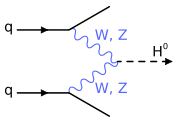
When activated, it is theorized that the collider will produce the elusive Higgs boson. The verification of the existence of the Higgs boson would be a significant step in the search for a Grand Unified Theory, which seeks to unify three of the four known fundamental forces: electromagnetism, the strong nuclear force and the weak nuclear force, leaving out only gravity. The Higgs boson may also help to explain why gravitation is so weak compared with the other three forces. In addition to the Higgs boson, other theorized particles, models and states might be produced, and for some searches are planned, including supersymmetric particles, compositeness (technicolor), extra dimensions, strangelets, micro black holes and magnetic monopoles.

Research
BosonFusion-Higgs When in operation, about seven thousand scientists from eighty countries will have access to the LHC. Physicists hope to use the collider to test various grand unified theories and enhance their ability to answer the following questions:
Is the popular Higgs mechanism for generating elementary particle masses in the Standard Model realised in nature? If so, how many Higgs bosons are there, and what are their masses?
Will the more precise measurements of the masses of the quarks continue to be mutually consistent within the Standard Model?
Do particles have supersymmetric ("SUSY") partners?
Why are there apparent violations of the symmetry between matter and antimatter? See also CP-violation.
Are there extra dimensions indicated by theoretical gravitons, as predicted by various models inspired by string theory, and can we "see" them?
What is the nature of dark matter and dark energy?
Why is gravity so many orders of magnitude weaker than the other three fundamental forces?
Is time travel (utilising either General theory of relativity or wormholes or black holes) possible?

Renowned British astrophysicist Stephen Hawking has bet £50 the mega-experiment will not find the elusive particle seen as the holy grail of cosmic science. "I think it will be much more exciting if we don't find the Higgs. That will show something is wrong, and we need to think again. I have a bet of 100 dollars that we won't find the Higgs," said Prof Hawking.[26]
Prof Hawking said the experiment could discover superpartners, particles that would be "supersymmetric partners" to particles already known about. "Their existence would be a key confirmation of string theory, and they could make up the mysterious dark matter that holds galaxies together," he said on the BBC. "Whatever the LHC finds, or fails to find, the results will tell us a lot about the structure of the universe," he said.

As an ion collider
The LHC physics program is mainly based on proton-proton collisions. However, shorter running periods, typically one month per year, with heavy-ion collisions are included in the programme. While lighter ions are considered as well, the baseline scheme deals with lead ions. This will allow an advancement in the experimental programme currently in progress at the Relativistic Heavy Ion Collider (RHIC).

Proposed upgrade
After some years of running, any particle physics experiment typically begins to suffer from diminishing returns; each additional year of operation discovers less than the year before. The way around the diminishing returns is to upgrade the experiment, either in energy or in luminosity. A luminosity upgrade of the LHC, called the Super LHC, has been proposed,[28] to be made after ten years of LHC operation. The optimal path for the LHC luminosity upgrade includes an increase in the beam current (i.e., the number of protons in the beams) and the modification of the two high luminosity interaction regions, ATLAS and CMS. To achieve these increases, the energy of the beams at the point that they are injected into the (Super) LHC should also be increased to 1 TeV. This will require an upgrade of the full pre-injector system, the needed changes in the Super Proton Synchrotron being the most expensive.
Cost
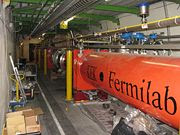
The total cost of the project is anticipated to be between €3.2 to €6.4 billion.[6] The construction of LHC was approved in 1995 with a budget of 2.6 billion Swiss francs (€1.6 billion), with another 210 million francs (€140 million) towards the cost of the experiments. However, cost over-runs, estimated in a major review in 2001 at around 480 million francs (€300 million) for the accelerator, and 50 million francs (€30 million) for the experiments, along with a reduction in CERN's budget, pushed the completion date from 2005 to April 2007.[29] 180 million francs (€120 million) of the cost increase have been due to the superconducting magnets. There were also engineering difficulties encountered while building the underground cavern for the Compact Muon Solenoid. In part this was due to faulty parts lent to CERN by fellow laboratories Argonne National Laboratory or Fermilab.

Computing resources
The LHC Computing Grid is being constructed to handle the massive amounts of data produced by the Large Hadron Collider. It incorporates both private fibre optic cable links and existing high-speed portions of the public Internet, to get data from CERN to academic institutions around the world.
The distributed computing project LHC@home was started to support the construction and calibration of the LHC. The project uses the BOINC platform to simulate how particles will travel in the tunnel. With this information, the scientists will be able to determine how the magnets should be calibrated to gain the most stable "orbit" of the beams in the ring.


Large Hadron Collider Panel

Related posts:


Source: en.wikipedia.org
0
The FAT file system divides space on a fixed disk into exactly 65,536 (16 bits’ worth, or 216) storage locations, and each location is assigned a number. The storage locations are also known as clusters.A cluster is the smallest unit of storage space on a FAT partition.

File location in these storage spaces is tracked by the File Allocation Table, which, as mentioned earlier, works very much like the table of contents for this book it’s simply a way of keeping track of the reality that in cluster (page number) x lives file (topic) y.


FAT32, then, is an updated version of FAT that generally uses smaller cluster sizes, simply because it creates so many more of them (232 of them, to be exact). Smaller cluster sizes generally result in more efficient use of a logical drive’s disk space and, moreover, support much larger drives.

But neither version of FAT is the default file systemused byWindows Vista at setup time. NTFS is the default, and this file system makes even better use of larger drives.Moreover, the NTFS file systemmakes available a host of improved security features over FAT.

So, why on earth would you want to format a drive using the FAT32 file system? In a word: compatibility. The FAT32 file system was first introduced with the release of Windows 95 OEM Service Release 2 (OSR2), and it has been supported on allWindows versions since then. If your goal is to store data on a drive thatwill be used on earlierWindows versions, FAT32 might be your best choice. However, it is not compatible with Windows NT versions 4.0 and earlier.

The NTFS File System

NTFS (or NT File System, depending on who you ask) was first used with the Windows NT operating system many years ago and has been steadily improved ever since. It provides the highest level of performance and features for Windows Vista computers and, thus, is the default file system used at installation. In fact, many of the enhancements to Windows operating systems over the years (especially in terms of security) are technically enhancements to the file system, which continues to evolve much like any other software component. And, as mentioned earlier, the big leap forward that Vista originally promised was indeed an overhaul of the file system used.

At the time of this writing,Vista uses NTFS version 3.1. The file systemtechnologies included with NTFS 3.1 include compression, quotas, and encryption technologies that haven’t always been a part of the Windows NTFS environment. All of these technologies get coverage within this book. NTFS supports volumes of up to 2 terabytes, and as with FAT32, cluster size is relatively small. This means NTFS makes efficient use of disk space and is well suited for larger drives.

Another significant advantage of NTFS is that it allows for local security of files and folders, which is especially important when two or more users are accessing the same computer.With NTFS, different users can be assigned different levels of access to a resource. For example, one user may have access permission to change a particular file,whereas another user has permission to only read that file.

This kind of local security is not possible with a FAT partition. The biggest drawback when using an NTFS volume is compatibility, although this is becoming less of an issue as time goes on.Windows 9.x computers don’t have the necessary file system drivers to read data from NTFS partitions. Windows 2000, XP, and Server 2003 operating systems do. About the only instance in which you would need to format your Vista systemdrive with the FAT file system today is if you plan to dual-boot with Windows 98.

This issue of file system choice is sometimes confused by the fact that a Windows 9.x computer can still access data housed on an NTFS partition as long as that access occurs over the network. In that case, the Vista computer fields the request from the Windows 9.x system and then retrieves the appropriate file system drivers needed to access the data. In practice, that means you can have a work group set up with some computers running Windows 9.x and some running Vista without having to worry about formatting all your Vista drives with FAT. If you’re already certified or have experience on Windows 2000 or Windows XP, you probably found much of the preceding discussion to be a review. And indeed it is: not much has changed in Windows Vista as far as file systems go. You might see a question or two about it on the 70-620 exam, however, because these choices do affect post-installation capabilities.